Selecting the right central heating system for a luxury villa or residential property in Egypt requires balancing initial installation pricing against long-term running costs. Understanding the true cost of underfloor heating vs radiators involves evaluating upfront supply and installation expenses, monthly electricity or gas bills, and 20-year structural return on investment (ROI). Below is an engineer-backed breakdown designed to help homeowners and real estate investors in Egypt make an informed financial decision.
Financial & Technical Metric | Hydronic Underfloor Heating | Traditional Wall Radiators |
Average Supply & Installation Cost per m2 | 1,800 – 3,200 EGP / m2 (Depending on floor finish & heat source) | 1,200 – 2,100 EGP / m2 (Based on radiator panel count) |
Average Initial Investment for 500 m2 Villa | 900,000 – 1,600,000 EGP | 600,000 – 1,050,000 EGP |
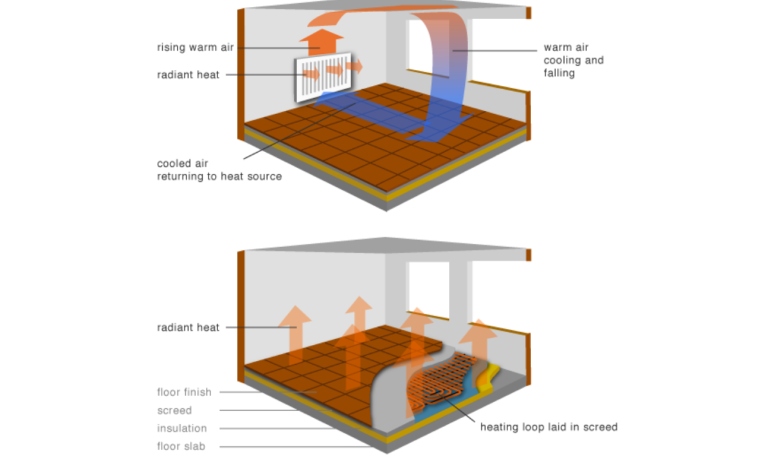
Required Water Flow Temperature | Low Temp: 35 °C – 45 °C | High Temp: 65 °C – 75 °C |
Monthly Energy Bill Savings | 30% – 50% Lower (vs Radiators / AC Heat) | Standard baseline consumption |
System Payback Period (ROI) | 3 to 5 Winter Seasons | N/A (Higher continuous running cost) |
Structural Infrastructure Lifespan | 50+ Years (Concealed zero-joint piping) | 15 – 20 Years (Exposed panels & valves) |
Make a confident decision on your heating infrastructure. Get in touch with Greenwell’s team to review your floor plans and receive a detailed breakdown covering the cost of underfloor heating vs radiators.
[callaction_btn]
When requesting a financial proposal for central heating in Egypt, several technical parameters determine your total expenditure and overall cost of underfloor heating vs radiators:
Larger open-plan spaces (e.g., double-height reception areas) favor underfloor heating, as radiators struggle to heat expansive volumes efficiently without adding numerous wall panels.
Utilizing 5-layer European PEX-AL-PEX multilayer composite pipes with EVOH oxygen barriers increases initial capital outlay compared to local plumbing pipes, but guarantees zero underground leaks or boiler corrosion.
While underfloor heating system requires a 20% to 35% higher upfront investment, it significantly outperforms traditional radiators in monthly operational costs.
Evaluating the true cost of underfloor heating vs radiators requires exact thermodynamic load calculations tailored to your architectural plans. Greenwell is a leading central heating engineering company in Egypt, backed by over 15 years of central heating experience.
Achieving maximum heating performance in your villa without overspending on installation or monthly bills relies on three integrated engineering strategies:

Comparing the initial cost of underfloor heating vs radiators for your villa or architectural project? Let Greenwell’s engineering consultants provide an accurate, transparent cost-benefit analysis and a customized heat loss calculation.
[callaction_btn]Yes. Underfloor heating generally costs 20% to 35% more upfront due to subfloor XPS insulation, high-density PEX-AL-PEX piping loops, and specialized thermal screed preparation.
When paired with an efficient European heat pump or condensing boiler, lower operational energy bills typically cover the initial price difference within 3 to 5 winter seasons.
Yes. Greenwell frequently designs hybrid central heating systems—utilizing hydronic underfloor heating in high-ceiling marble reception areas on the ground floor and radiators in upper-floor bedrooms, managed via a dual-temperature manifold.
Underfloor heating is substantially cheaper to run. Inverter heat pumps achieve maximum electrical efficiency when supplying low-temperature water (35C - 45C, which matches underfloor heating requirements perfectly.
Yes. Properties equipped with smart, concealed hydronic floor heating in top Egyptian developments (such as Katameya Heights, Hyde Park, New Giza, or El Gouna) command higher resale values and rental yields due to their luxury status and lower operating costs.